



Background
Wessex Water was tasked with resolving a historic surface water flooding problem affecting a busy residential area on the outskirts of Bath. Properties in the area had experienced repeated flooding during heavy storm events, requiring a long term solution capable of providing significant storage during extreme rainfall.
The location was heavily constrained, with no available land to accommodate traditional offline attenuation tanks or open SuDS features. As a result, any solution needed to be delivered entirely within the existing carriageway.
The challenge
The scheme faced a number of complex constraints:
- No land available for conventional storage tanks or ponds
- Requirement to deliver large stormwater storage volumes
- Deep excavation within a residential road, reaching up to 6.5 m at the deepest point
- Extensive existing utilities criss crossing the carriageway
- Construction carried out under a full road closure
- A strong driver to complete the works as quickly as possible to minimise disruption to residents
The solution needed to be compact, buildable and capable of delivering storage without increasing footprint or construction risk.
The solution
The agreed drainage strategy involved installing two large diameter precast concrete pipelines inline to act as stormwater storage tanks beneath the carriageway.
Key elements included:
- A 1600 mm diameter precast concrete sewer, approximately 60 m in length, forming the deepest storage section
- A backdrop manhole at the upstream end of the 1600 mm tank, maximising available storage volume and reducing the depth of excavation further upstream
- A reduction to a 225 mm diameter pipe, acting as a throttle, supplemented by a mechanical flow control device
- A second inline storage tank, 1800 mm in diameter and approximately 70 m long, installed further upstream
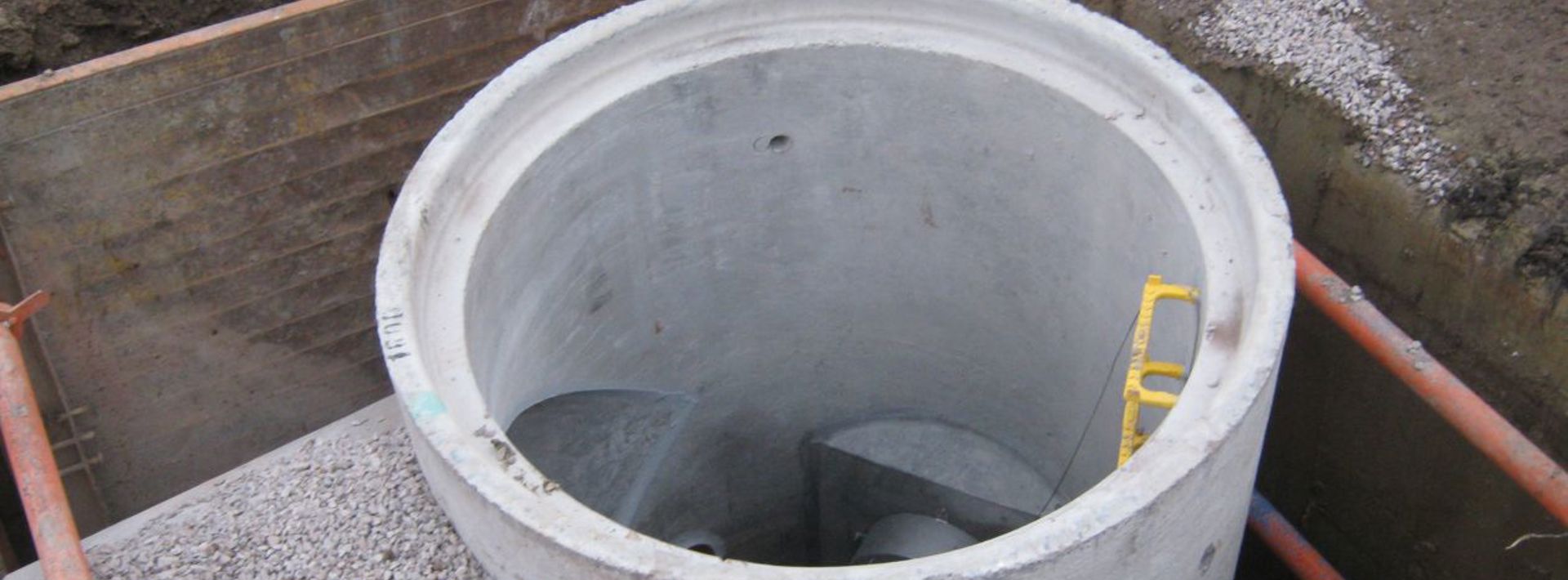
Given the depth of excavation and sensitive residential setting, the contractor opted to use preformed side entry manholes supplied by Marshalls. These access points were installed at regular intervals along both large diameter tanks.
Under traditional construction, 3000 mm diameter manholes would have been required. By using side entry access chambers:
- Large access shafts were eliminated
- Construction time, materials and excavation volumes were reduced
- The overall footprint of the storm tanks was minimised
- Conflicts with existing utilities were significantly reduced
This approach was critical in enabling the scheme to be delivered efficiently under a full road closure.
The outcome
The completed scheme delivers a high capacity, in line attenuation solution within an extremely constrained residential environment.
- Effective control and storage of surface water during heavy storm events
- Flood risk significantly reduced for nearby properties
- No requirement for additional land take
- Reduced construction footprint and programme duration
- High quality, maintainable drainage infrastructure
The project demonstrates how bespoke in carriageway storage design, using large diameter precast pipelines and innovative access solutions, can successfully resolve historic flooding problems where conventional approaches are not viable.


