



Blog
Reducing embodied carbon in water infrastructure: From measurement to meaningful action


Blog
The UK water sector faces a significant challenge. As the industry invests billions of pounds in new infrastructure to improve resilience, manage storm overflows and support growing communities, it must also reduce the carbon impact of the assets it delivers.
While operational carbon has been a major focus for many years, embodied carbon is increasingly taking centre stage. Locked into infrastructure at the point of construction, embodied carbon represents one of the biggest opportunities to accelerate progress towards net zero.
At Marshalls Civils & Drainage, we believe that we believe that transparency, collaboration and innovation are important enablers of carbon reduction. From understanding Environmental Product Declarations (EPDs) to developing new low-carbon concrete technologies, the industry has a growing range of tools available to make more informed decisions.
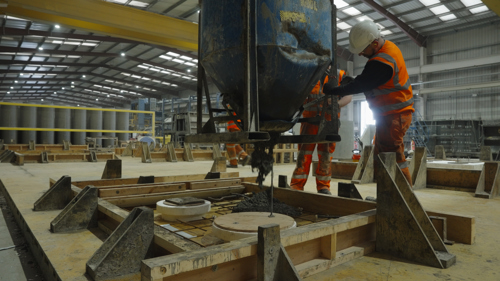
For many concrete infrastructure products, the majority of carbon emissions occur before a product even reaches site. Raw material extraction, cement production, manufacturing and transportation all contribute to a product's overall embodied carbon footprint.
Cement remains one of the largest contributors to carbon emissions within concrete production. Globally, cement manufacturing accounts for approximately 7-8% of CO₂ emissions, making it a critical area of focus for the construction sector.
For asset owners, designers and contractors, reducing embodied carbon is no longer simply a sustainability aspiration. Increasingly, it is becoming a project requirement driven by net-zero commitments, carbon reporting frameworks and customer expectations.
Before carbon can be reduced, it must first be measured.
Environmental Product Declarations (EPDs) provide a standardised and transparent method of assessing the environmental impact of construction products throughout their lifecycle. They enable clients and designers to make reasonable and credible product comparisons on a like for like basis and make evidence-based decisions.
However, requesting EPDs is one thing, understanding them is where the real value lies.
When reviewing an EPD, stakeholders should consider:
For many precast concrete products, the product stage (A1-A3) typically accounts for the majority of emissions, making it a key area for carbon reduction initiatives. It is also worth considering A4 as this represents the carbon impact of the delivery to site, which is important if you’re thinking of using an imported product.
There is no single solution to low-carbon concrete. Instead, the industry is progressing through a series of developments that collectively reduce embodied carbon while maintaining the performance and durability required for critical infrastructure.
The simplest and often most effective starting point is optimising existing concrete mixes.
Through careful quality control, process standardisation and material optimisation, it is often possible to reduce cement content without compromising product performance. In many cases, this can achieve meaningful carbon reductions while also improving production efficiency.
Supplementary Cementitious Materials (SCMs), such as Ground Granulated Blast Furnace Slag (GGBS), Pulverised Fuel Ash (PFA), limestone and calcined clays, offer significant opportunities to reduce cement use.
As the proportion of SCMs increases within a concrete mix, embodied carbon can decrease substantially. However, achieving this requires careful consideration of strength development, durability requirements and material availability.
The challenge is not simply replacing cement, but doing so while ensuring products continue to meet the demanding standards expected within the water industry.
One of the most promising developments in recent years has been the emergence of carbon-capture technology within cement production.
Carbon-captured cement has the potential to contribute to reductions in embodied carbon, depending on the technology used and project-specific circumstances.
By capturing emissions associated with cement manufacture and preventing their release into the atmosphere, these technologies have the potential to reduce the carbon footprint of concrete products. Actual reductions will vary depending on the specific technology, manufacturing process and product application.
For infrastructure clients seeking options to support embodied carbon reduction objectives, this technology represents a promising area of development.
Alongside more incremental improvements, manufacturers are also investigating radical alternatives including geopolymer concretes and other advanced binder systems.
At Marshalls, ongoing trials are exploring the potential of clinker-free and cement-free technologies for precast products. While further development is still required, these innovations could play an important role in the future decarbonisation of the infrastructure sector.
Carbon reduction is closely linked to circular economy principles.
The construction industry has a significant opportunity to reduce its dependence on virgin materials by increasing the use of recycled and secondary resources. Materials such as recycled aggregates, recycled concrete fines and incinerator bottom ash aggregate (IBAA) offer the potential to reduce reliance on virgin materials and support circular economy objectives.
Initial trials using alternative aggregate materials have demonstrated encouraging performance results, highlighting how circularity can support both sustainability objectives and resource efficiency.
While materials innovation is essential, technology alone will not deliver the industry's net-zero ambitions.
The biggest opportunities often emerge when clients, designers, contractors and manufacturers collaborate early in the project lifecycle. Setting embodied carbon targets during the design stage creates the space needed for innovation and allows alternative materials, products and construction methods to be properly evaluated.
Transparency through EPDs, performance-based specifications and pilot projects will all play a vital role in accelerating adoption and building industry confidence.
The path to net zero will require a combination of innovation, transparency and practical action.
From optimised mix designs and advanced SCMs to carbon-captured cement and circular material streams, many of the technologies that could support embodied carbon reduction already exist or are continuing to develop. The challenge now is deploying them at scale.
For the water sector, the opportunity is clear: by embedding carbon considerations into design decisions from the outset, infrastructure projects can deliver both the resilience communities need and the sustainability outcomes the future demands.
At Marshalls, we are committed to supporting that transition through continued investment in lower-carbon material technologies, transparent reporting and collaborative engineering approaches designed to help customers address sustainability objectives.
Written By

Mike Edwards is the Head of Sustainability for Marshalls plc, where he leads the business's sustainability strategy while helping ensure environmental ambitions translate into practical, measurable improvements across the organisation.
