



Blog
The hidden danger beneath our feet: why manhole safety must improve


Blog
Across the UK's water, wastewater and stormwater networks, manholes serve a simple but essential purpose: they enable access, inspection and emergency intervention. Yet the industry often overlooks the period when these structures are at their most vulnerable. The greatest risks associated with manholes frequently emerge long before the system is operational, argues Paul Curtis, Managing Director of Marshalls Civils & Drainage.
Anyone who has worked on drainage installations will be familiar with the challenges of the early construction phase. Manholes are often installed weeks before the surrounding infrastructure takes shape. During this period, open chambers can be exposed, loosely protected or covered using temporary solutions that were never designed for the task.
On a live, fast-moving construction site, these improvised approaches rarely stand up to changing weather conditions, increasing footfall or multiple contractors working in close proximity. Despite the strong safety culture that exists across much of the industry, temporary manhole protection remains one of the most persistent weak spots in the construction process.
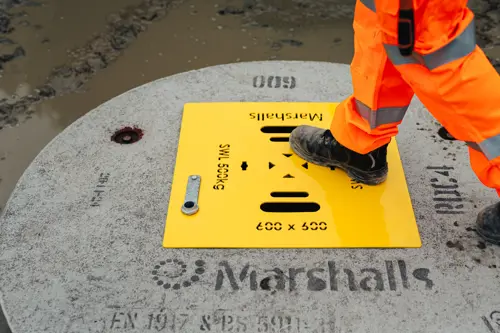
The moment a manhole is first installed is often the moment it is most vulnerable. Ground conditions may still be incomplete, surrounding assets may not yet be in place, and numerous trades can be operating in the same area.
The Health & Safety Executive (HSE) requires openings and excavations to be adequately protected to safeguard workers and the public. Yet the way this has historically been achieved has varied considerably from site to site. Temporary barriers, plywood sheets, loose metal plates and other improvised measures can still be found across some projects, creating inconsistency in how risk is managed.
The challenge is not a lack of awareness. Most contractors understand the dangers posed by open chambers. The issue is that temporary protection has often been viewed as a site-managed problem rather than something that can be engineered into the solution from the outset.
The consequences of inadequate protection can be significant.
Falls from height remain the leading cause of fatal workplace injuries in Great Britain and continue to account for a substantial proportion of fatalities within the construction sector. As construction activity increases and projects become more complex, managing risks associated with openings, chambers and access points remains a critical priority across the industry.
Unprotected manholes can also create wider operational and environmental risks. Debris, runoff and contaminants can enter open chambers, potentially causing blockages, pollution incidents or damage to newly installed infrastructure before it has even entered service.
These risks become even more important when viewed against the backdrop of AMP8, the largest investment programme the UK water sector has ever undertaken. With more projects being delivered, faster construction programmes and increased numbers of temporary openings on site, the industry's exposure to risk is only likely to grow.
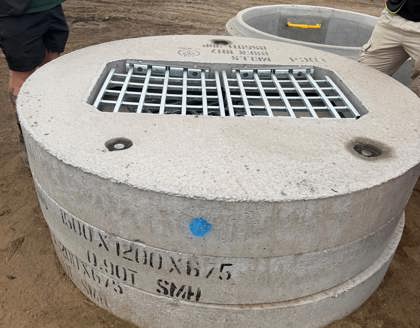
For decades, the water sector has focused on designing and manufacturing underground assets that deliver long-term performance. Increasingly, the same engineering mindset is being applied to the construction phase itself.
Contractors, utilities and local authorities are placing greater emphasis on designing risk out of projects wherever possible, rather than relying solely on procedural controls or temporary site measures. As a result, there is growing recognition that purpose-designed temporary protection is not simply a compliance consideration; it is an important element of modern construction safety.
In many areas of construction, risks that were once managed through site improvisation have gradually been engineered out through product innovation and standardised solutions. Temporary chamber protection appears to be following the same path.
Feedback from contractors consistently highlights the same requirements. Temporary protection solutions must be easy to install, durable enough for demanding site conditions, practical to remove when work is complete and capable of providing reliable protection throughout the construction programme.
These changing expectations are helping to drive the development of purpose-designed temporary and permanent safety solutions that offer a more consistent approach to protecting open chambers during construction.
Marshalls has recently expanded its range of manhole safety solutions with the introduction of the Safety Cover Slab alongside its established Manhole Safety Cover. Designed for different installation scenarios, both solutions provide protection during the construction phase and support safer working practices around open chambers.
While the products differ in their application, they share a common objective: helping contractors reduce the risk of accidental falls without disrupting installation activities or construction progress.
More importantly, they reflect a wider shift taking place across the industry. Rather than relying on temporary, improvised approaches to site safety, contractors are increasingly seeking engineered solutions that provide greater consistency, reliability and confidence.
The water industry is entering a period of unprecedented investment and activity. As AMP8 projects begin to accelerate, there is a significant opportunity to rethink how risks are managed on site.
Improving manhole safety is not about introducing additional layers of compliance. It is about recognising that construction-phase risks deserve the same level of engineering consideration as the permanent assets being installed.
The sector has made enormous progress in designing more efficient, resilient and sustainable infrastructure. Applying that same innovation to works and site safety is a natural next step.
Because when it comes to protecting people on site, the safest risks are the ones designed out before construction even begins.
Written By

Paul has been with Marshalls plc for 24 years, and for the last five, has served as Managing Director of Marshalls Civils & Drainage.

