Standard Channel and Edging
Colour and finish options
Plan your project
Contact the landscaping team

MaDE - Design and Engineering service
Product Details
Marshalls uses hydraulic pressing in the manufacture of its standard natural kerb, channels and edgings. The result is the durability and consistent long-term performance you would expect from Marshalls with a functional unit of this type.
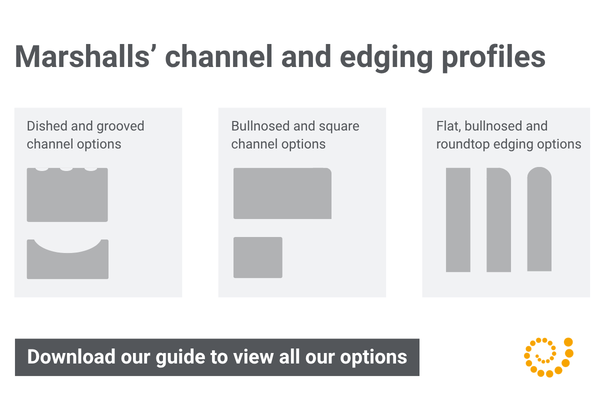
These precision-manufactured products are available in many different shapes and profiles to fulfil a wide range of design requirements.
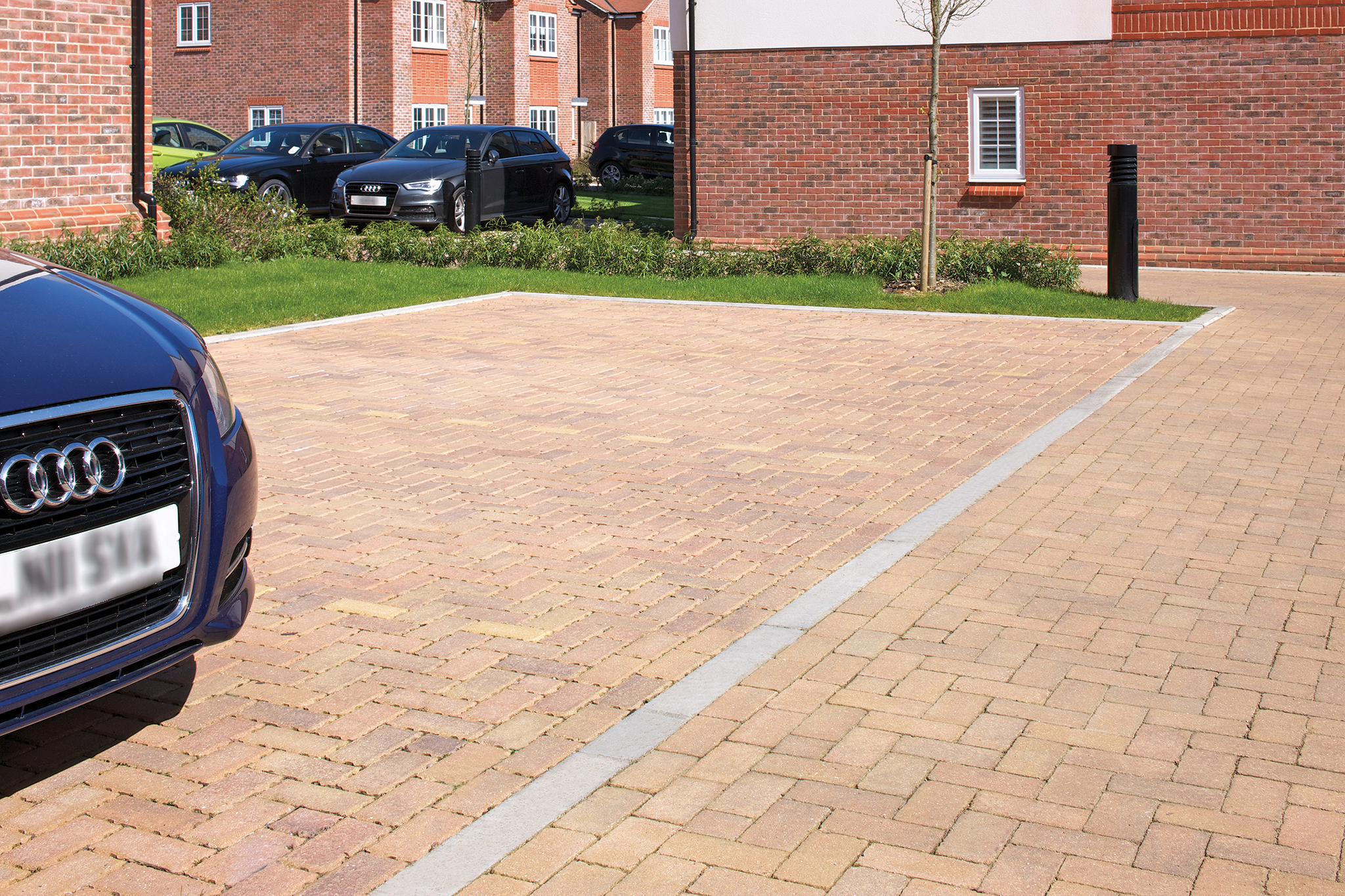
Bullnose and Square channels are typically used as a spacer between the kerb and the carriageway or for off-road parking and lay-bys, while Concrete Dished channels provide an aid to drainage. Bullnose, Round Top and Flat Top concrete edging is mostly used along footpath edges.
Download the EPD for Standard Channel & Edging here.
Click the image below to take a look at our kerb guide featuring British Standard channels and edgings:
Dished channels
Concrete dished channel sits along the edge of roads, driveways and car parks, acting as a shallow gutter that collects and directs surface water toward drainage points, helping to prevent pooling. Available in 150 x 100mm, 255 x 125mm, 230 x 75mm, 305 x 90mm and 305 x 150mm sizes, dished channel is manufactured using the same hydraulic pressing process as our British Standard Kerb range for consistent, long-term performance.
Square & bullnose channels
Square and bullnose channels sit between the kerb and the carriageway, providing structural support and a clear line of separation from off-road parking, lay-bys and footpaths. As well as marking this boundary, channel kerb helps direct surface water toward drainage points, reducing the risk of pooling and surface erosion at the road edge. Square channels available in 150 x 125mm, 150 x 150mm and 255 x 125mm. Bullnosed edging available in 50 x 250 x 914mm, 50 x 200 x 914mm and 50 x 150 x 914mm.
Edgings
Bullnose, round top and flat top concrete edging is most commonly used along footpath edges, available in 150mm, 200mm and 250mm depths.
- Highly durable channels and edging
- Hydraulic pressing ensures long-term performance
- Different shapes and profiles to fulfil a range of design requirements
- Precision-manufactured from natural stone